

Class II A2 vs B2 Biosafety Cabinets: How to Choose
Short answer: choose a Class II Type A2 cabinet for most biological work, including cell culture and BSL-2 microbiology, when no volatile toxic chemicals are used. Choose a Type B2 only when the same work also involves volatile toxic chemicals or radionuclides and your building can supply a dedicated exhaust duct and fan.
- Duct
- Not required
- Exhaust goes
- Into the room, or a canopy connection
- Choose it for
- Biological work without volatile toxic chemicals
- Duct
- Hard-ducted, dedicated exhaust
- Exhaust goes
- Outside, through the building exhaust fan
- Choose it for
- Biological work with volatile toxic chemicals or radionuclides
How each cabinet moves air
Both types protect three things at once. Room air drawn in through the front grille protects the operator, filtered air flowing down over the work surface protects the sample, and the exhaust filter protects the room. The difference is where the air goes after it passes the work surface.
Class II A2
About 70% recirculates through the supply filter. About 30% leaves through the exhaust filter.
In an A2, about 70% of the downflow is filtered and blown back over the work area, and about 30% is filtered and exhausted. HEPA and ULPA filters trap particles, not chemical vapors, so any vapor released in the work zone keeps circulating inside the cabinet and can return to the room.
Class II B2
Nothing recirculates. All of the air leaves through a hard duct to the building exhaust.
In a B2, nothing recirculates. The building exhaust pulls all of the air through the cabinet and out through the exhaust filter, so vapors leave with it. This also makes a B2 dependent on the building: if the exhaust fails, the cabinet becomes pressurized and air from the work zone can be pushed out of the front opening. BMBL calls for an interlock that stops the supply blower and an alarm that warns the user when exhaust flow drops.
A2 and B2 side by side
When an A2 is the right choice
- Cell and tissue culture, microbiology and virology at BSL-1 or BSL-2
- Clinical and diagnostic samples, PCR set-up and sterile media handling
- Labs without a dedicated exhaust duct, or where the cabinet may be moved later
If a protocol needs minute amounts of volatile chemicals, an A2 can be connected to the building exhaust through a canopy (thimble) connection with an exhaust alarm. Unlike a hard duct, a canopy leaves an air gap between the cabinet and the duct, and BMBL states that A2 cabinets should never be connected directly to the building exhaust.
When you need a B2
- Protocols that combine biological agents with volatile toxic chemicals
- Work with volatile radionuclides
- Your biosafety officer's risk assessment calls for total exhaust
A B2 only works as well as the building exhaust behind it. Check the four items below with your facilities team before you order.
What a B2 needs from the building
Before ordering a B2, confirm with your facilities team that the building can provide:
-
1Exhaust fan and duct routeA dedicated exhaust fan sized for the cabinet, and a duct route to the outside.
-
2Airflow alarm and interlockAn airflow monitor and alarm, and an interlock that stops the cabinet blower if exhaust flow drops.
-
3Make-up airEnough supply air to replace what the cabinet removes: BMBL puts it at up to 1,200 cfm, and a LORDERAN B2 exhausts about 620 to 1,060 cfm depending on width.
-
4Field certificationCertification after installation and balancing.
Cost of ownership
A B2 costs more to run. It removes conditioned room air for as long as it operates: a 3 ft LORDERAN B2 exhausts about 1,050 m³/h (620 cfm), roughly three times the 360 m³/h that a 3 ft A2 returns to the room through its exhaust filter.
Every LORDERAN B2 ships with an exhaust blower and a 4 m PVC duct (300 mm diameter). The route through the building, the roof penetration, airflow balancing and the extra supply air are still building work outside the cabinet price. An A2 that exhausts into the room needs only a power outlet.
Both types should be field certified to NSF/ANSI 49 when installed, after they are moved, and at least once a year.
Air each cabinet sends out of its exhaust, m³/h
LORDERAN listed figures. A2 air returns to the room; B2 air leaves the building and must be replaced.
Bars share one scale, starting at zero.
A three-question check
LORDERAN A2 and B2 cabinets
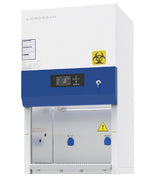
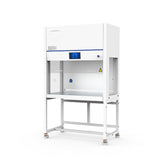
Every LORDERAN Class II cabinet uses two ULPA filters rated 99.9995% at 0.12 μm, one for the downflow and one for the exhaust, which gives an ISO Class 3 work zone. All of them have a motorized, UV-blocking front window, audible and visual alarms for abnormal airflow, filter change and an unsafe window height, and interlocks that keep the UV lamp off while the window is open. Noise is 67 dB(A) or less, every model comes in 110 V or 220 V, and the warranty is 3 years.

- 3, 3.8, 4.4 and 5.3 ft
- 360 to 620 m³/h into the room
- Standard controller

- 3 to 5.6 ft, four widths
- 360 to 620 m³/h into the room
- 7-inch touch screen

- 3, 4 and 6 ft
- 441 to 824 m³/h (259 to 485 cfm)
- LCD, m/s (GL) or fpm (NA)

- 2 ft benchtop
- 230 m³/h into the room
- Standard controller

- 2 ft benchtop
- Exhaust into the room
- 7-inch touch screen

- 3, 3.8, 4.4 and 5.5 ft
- 100%, 1,050 to 1,800 m³/h via duct
- Standard controller

- 3, 4.4 and 5.25 ft
- 100%, 1,050 to 1,800 m³/h via duct
- 7-inch touch screen
Every model page has a datasheet, a user manual and a one-click PDF quotation.
Prices as of November 2026, with free delivery and duties paid to your loading dock.
Which model fits your lab
Questions buyers ask
Can an A2 cabinet be hard-ducted to the building exhaust?
No. An A2 should use a canopy (thimble) connection with an exhaust alarm. BMBL states that Type A1 and A2 cabinets should never be connected directly to the building exhaust system.
Is a B2 safer than an A2?
Not for biological work alone. Both types meet the same 100 fpm minimum inflow and protect the operator, the sample and the room. A B2 adds removal of chemical vapors, but it depends on the building exhaust, and an exhaust failure pressurizes the cabinet.
Can a biosafety cabinet replace a chemical fume hood?
No. A fume hood protects the operator from chemical vapors but does not protect the sample or filter what it exhausts. A recirculating A2 filters particles but not vapors. Use a B2, or an A2 with a canopy connection for minute amounts, only when biological and chemical hazards are combined.
What inflow velocity do LORDERAN cabinets run at?
The standard and Pro A2 and B2 models run at 0.53 m/s (about 104 fpm) inflow and 0.33 m/s (about 65 fpm) downflow, both held within ±0.025 m/s and tested with the front window at 200 mm (8 in). That is above the 100 fpm minimum inflow for Class II Type A2 and B2 cabinets.
How often does a biosafety cabinet need certification?
Field certification to NSF/ANSI 49 is done when the cabinet is installed, after it is moved, and at least once a year.
