

How to Use a Lab Autoclave: Loading, Cycles and Safe Unloading
Last updated November 2026 · LORDERAN how-to guide
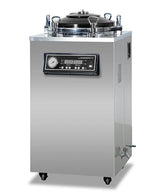
Short answer: fill the chamber with distilled water to just below the shelf, load wrapped items with gaps for steam and liquids no more than three-quarters full under cotton plugs, and pick the right program: no exhaust and no drying for liquids, exhaust and drying for solids. A common cycle is 121 °C (250 °F) for 30 minutes. Open the lid only when the pressure gauge reads zero, put an indicator in every load and run a spore test regularly. The figures come from the LORDERAN vertical autoclave manual (35 to 100 L) and the CDC sterilization guideline.
1. Install and fill
The vertical autoclave makes its own steam from water in the bottom of the chamber, so the water level and water quality matter every cycle.
Where it goes
-
1Level, firm floorWith 60 cm (24 in) clear from the walls.
-
2The right room5 to 40 °C (41 to 104 °F) and no more than 85 %RH.
-
3Its own grounded outletA dedicated outlet with a clearly marked disconnect, at the voltage on the rating plate (220 V, or 110 V 60 Hz versions). Never remove the ground wire.
-
4Drain hose end in the airThe outlet of the drain hose must never sit under water, or water can be drawn back into the chamber.
Water
-
1Distilled waterTap water is not recommended.
-
2About 5 L, below the shelfThe level reaches the foot of the chamber, under the shelf. Top up after every cycle when you run several in a row.
-
3Auto-fill modelsPut the inlet hose to the bottom of a 5-gallon bucket of water. Filling stops when the water light turns steady green.
-
4DrainingWait at least 2 hours after a cycle, with the lid open, before you drain hot water.
2. Load it
-
1Leave room for steamWrap items properly and leave gaps between them. Center the basket; stack baskets one above the other.
-
2LiquidsHeat-resistant glass bottles, no more than ¾ full, closed with a cotton plug. No solid rubber stoppers or corks.
-
3Open vesselsBeakers, flasks and tubes go upside down or on their side, so air can drain out and steam can get in.
-
4One kind per loadDo not mix dressings and liquids in the same load.
-
5An indicator in every loadPut a chemical indicator card in the load.
3. Choose the cycle
The controller sets 116 to 134 °C and 4 to 120 minutes of sterilizing time, with up to 240 minutes of drying. CDC gives 121 °C (250 °F) for 30 minutes as the minimum exposure for wrapped items in a gravity-displacement autoclave like this one.
-
AProgram A: liquidsSterilizes only, with no automatic venting and no drying. Use it for media and solutions.
-
CMode C: solidsSterilizes, exhausts the steam and dries. Use it for wrapped instruments, glassware and dry goods. Never use drying for liquids.
-
✓Air comes out firstThe autoclave vents the cold air in three pulses between about 105 and 115 °C before it climbs to the set temperature, because trapped air keeps steam away from the load.
-
!Leave the venting settings aloneThe end-of-exhaust temperature can be set from 110 to 120 °C. Change it only when you need to.
Shape of a typical Mode C cycle. Heat-up and drying times depend on the load.
4. Run and unload
The end of the cycle, when the lid opens, is where pressure and heat can hurt you.
Close and start
-
1Close the lidSlide the crossbeam to the left column and turn the handwheel clockwise until the door light comes on, then on until sealed.
-
2StartCheck the program and the time, then start. Do not touch the lid during the cycle.
Wait for zero
-
1Gauge at zeroOpen the lid only after the pressure gauge reads zero. Forcing it earlier damages the lock.
-
2LiquidsNever vent a liquid load. Wait for zero, then let the liquid cool before you take the bottles out.
-
3After dryingIf the lid holds by vacuum, lift the relief valve bonnet to let air in.
Unload
-
1Gloves onWear heat-protective gloves for hot items.
-
2Read the indicatorCheck the indicator card before you use the load.
-
3Take it out promptlyThe autoclave is not for storage. Leave the lid open 5 minutes before the next cycle.
5. Prove it worked
The temperature reading shows the chamber got hot; indicators show the conditions reached the load.
-
1Every loadA chemical indicator, checked before the load is used.
-
2At least weeklyA biological indicator (spore test), as CDC recommends for steam sterilizers.
-
3After installation, a move or a major repairThree consecutive cycles with biological and chemical indicators before routine use, and the same after a sterilization failure.
-
4A positive spore testRepeat the test straight away. If it stays positive, stop using the autoclave until it has been serviced.
Error codes
Cut the main power before you troubleshoot. Most repairs need qualified service personnel. The alarm light also flashes when the waste water tank is full.
Maintenance
Disconnect the power and let the autoclave cool before any cleaning. Before moving it, drain the chamber, close the lid and switch off.
Manuals and guides
Each LORDERAN autoclave has its own manual with its programs, limits and error list.
Questions
Is 121 °C for 30 minutes always right?
It is the CDC minimum for wrapped items in a gravity-displacement autoclave. Large liquid volumes and dense loads take longer to reach temperature, so validate your own loads with indicators.
Can I dry a liquid load?
No. Use Program A for liquids: it does not vent or dry. Drying is for solids only.
Why won't the lid open?
The chamber is still under pressure, or, after drying, under vacuum. Wait for the gauge to read zero; after drying, lift the relief valve bonnet to let air in.
Can I use tap water?
The manual specifies distilled water and does not recommend tap water. Clean out scale from the walls, heater and probes every month either way.
How full can I fill bottles?
No more than three-quarters, in heat-resistant glass with a cotton plug. Solid rubber stoppers and corks are not allowed.
How often should I run a spore test?
CDC recommends a biological indicator at least weekly, plus three consecutive cycles with indicators after installation, a move, a major repair or a failure.
