

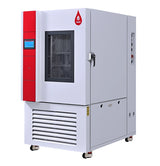
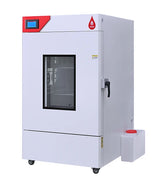


LORDERAN Programmable Two-Zone Thermal Shock Chamber, High-Low Temperature Recovery Impact Test chamber, MIL-STD Compliant
- SKU
- TS-100J
- Availability
- In stock
- Questions
 LORDERAN Programmable Two-Zone Thermal Shock Chamber, High-Low Temperature Recovery Impact Test chamber, MIL-STD Compliant
$30,648
Thermal shock tests for electronics, solder joints, packages and seals: a basket moves your samples between a hot zone (+60 to +200 °C) and a cold zone (−10 to −65 °C) in 15 seconds or less, in three sizes from 50 to 200 L. It has no humidity control, and the site needs three-phase power, compressed air for the basket lift and, for the 100 L and 200 L, a water chiller.
How hard is the shock?
For example +150 °C to −55 °C in one move: the basket crosses in ≤ 15 s, and each zone is back at its set point within 5 min.
How much can I load?
Up to 40 kg in the 50 and 100 L, 60 kg in the 200 L. Test areas from 370 × 360 × 380 to 650 × 650 × 500 mm.
What does the site need?
Three-phase power (208 to 480 V), compressed air at 5–7 kgf/cm² on an 8 mm line, and a 10–12 or 12–15 HP chiller for the 100 or 200 L. The 50 L can be air-cooled.
Can I use one zone alone?
Yes: high-temperature ageing or burn-in in the hot zone, or low-temperature storage and functional tests in the cold zone.
Hot, cold, hot again: in seconds
The hot zone is pre-heated and the cold zone pre-cooled. A pneumatic carrier moves the specimen between them in 15 seconds or less, and each zone recovers its set temperature within 5 minutes, so every cycle delivers the same, severe shock.
Specifications
Models CJ100 (50 L), CJ200 (100 L) and CJ500 (200 L), 3-phase power.
Download the full datasheet (PDF)Differs between models
| Model | 50 L | 100 L | 200 L |
|---|---|---|---|
| Model | |||
| Test Space Volume | 50 L | 100 L | 200 L |
| SKU | CJ100 | CJ200 | CJ500 |
| Dimensions and load | |||
| Inner size, whole chamber (W × D × H) | 450 × 450 × 500 mm | 600×600×600 mm | 800×800×800 mm |
| External size (W × D × H) | 900 × 2050 × 2000 mm | 1100 × 2220 × 2100 mm | 1120 × 2400 × 2200 mm |
| Test area size (W × D × H) | 370 × 360 × 380 mm | 430 × 490 × 500 mm | 650×650×500 mm |
| Load capacity of test area | 40 kg | 40 kg | 60 kg |
| Temperature performance | |||
| Temperature range | −65 to 200 °C | ||
| Temperature fluctuation | ±2 °C | ||
| Test area temperature fluctuation | ±0.5 °C | ||
| Hot exposure range | +60 to +200 °C | ||
| Heat-up time | Within 30 min, ambient to +200 °C | ||
| Cold exposure range | −10 to −65 °C | ||
| Pull-down time | Within 80 min, ambient to −65 °C | ||
| Temp. recovery time | Within 5 min | ||
| Transfer time between hot & cold chambers | Within 15 seconds | ||
| Power and refrigeration | |||
| Power supply | 3-phase: 208, 220–240, 400, 415 or 480 V; 50/60 Hz | ||
| Installed Power | 15 kW | 21 kW | 28 kW |
| Rated current | 49 A at 208 V, 43 A at 240 V, 22 A at 480 V | 69 A at 208 V, 59 A at 240 V, 30 A at 480 V | 92 A at 208 V, 80 A at 240 V, 40 A at 480 V |
| Cooling method | Air- or water-cooled (water: 8–10 HP chiller required) | Water-cooled (10–12 HP chiller required) | Water-cooled (12–15 HP chiller required) |
| Compressed air | 5–7 kgf/cm² (about 0.5–0.7 MPa, 71–100 psi), 8 mm connection; drives the basket lift | ||
| Refrigeration system | Binary cascade | ||
| Refrigerant | R404A and R23 | ||
| Noise level | Max. 65 dB | ||
Choose a size
Same zones, controller and safety on every size. Front elevations drawn to the same scale.
One test cycle, fully automatic
Set the limits, the dwell time and the number of cycles. The chamber does the rest and logs the data.
Simplified section, not to scale. The numbers match the steps below; screen values are an example.
Pre-heat and pre-cool
High-power heaters bring the hot zone up while the cascade system pulls the cold zone down.
Load the specimen
Place the device under test in the carrier, up to 40 kg (60 kg on the 200 L).
Automatic transfer
A pneumatic lift, run on your compressed-air supply, moves the carrier between zones in 15 seconds or less, for the dwell you set.
Repeat and record
Run up to 99 segments per program, with the curve and run time on screen.
Built for long shock campaigns
Repeatable transfers, zones you can run alone, and protection for unattended runs.
Independent zones and doors
Hot and cold rooms are controlled separately, reducing heat loss and cold leakage.
Use each zone alone
Run high-temperature aging or burn-in, or low-temperature storage, in a single zone.
Binary cascade refrigeration
Fully enclosed compressors imported from France, with energy regulation.
LCD touch screen
Parameters, test curve, run time and heater status at a glance, with PID auto-tuning.
10 × 99 programs
Programmed cycling or constant mode, set to 0.1 °C and 1 second.
Independent over-temperature protection
A separate hardware instrument backs up the main controller.
RS-485 and remote software
Connect the chamber to a PC for remote data.
Fault display and run-time counter
Automatic alarms, plus cumulative hours for maintenance planning.
Why the joints crack
Bonded materials expand at different rates: about 2.6 ppm/K for a silicon die, 17 for copper and 21 for lead-free solder. Swing from +150 to −55 °C within seconds and that mismatch strains every joint, cycle after cycle, until the weak ones crack.
Movement exaggerated for clarity. Typical expansion coefficients near room temperature. Over a 205 K swing, a 20 mm span of silicon grows about 11 µm, the same span of copper about 70 µm; the solder joints take up the difference.
Thermal shock or rapid temperature change?
Two ways to stress a product with temperature. Choose by how fast the change must be, and whether you need humidity.
Test standards
Standards listed for this chamber.
Show all 7 standards: RTCA DO-160, IEC 60068-2-14, ISO 16750 and more
Questions buyers ask
Compressed air, warranty, returns, delivery and quotes.
Does it need compressed air?
Yes. The basket is moved between the zones by a pneumatic lift, so the installation site needs a clean, dry compressed-air supply at 5–7 kgf/cm² (about 0.5–0.7 MPa, or 71–100 psi), connected with an 8 mm air line.
What does the warranty cover?
A 3-year worldwide warranty from the date of purchase, covering core components and controls. We repair first; if a major defect can’t be repaired, we replace the unit or give a full refund. Seals, heating tubes and other wear parts are excluded. A 2-year extended warranty can be added in the configurator.
Can I return it?
Yes, within 30 days of delivery if unused and in original condition. For non-quality returns the buyer pays return shipping, a 3% restocking fee and the card processing fee. Defective or damaged items are covered in full.
How is it delivered, and when does it ship?
Freight, duties and taxes are paid to your loading dock; moving the chamber inside is not included. Your confirmed ship date is included in the order acknowledgement.
Can I get a formal quote for a purchase order?
Yes. Select your size and options, then click Get a quote for a PDF quotation with DDP shipping included.
Download documents
The datasheet and the English user manual cover all three sizes.
Choose size, voltage and options
The price, delivery date and PDF quote update with your choices.