

Nitrogen vs Electronic Dry Cabinet: Which Do You Need?
Short answer: choose an electronic dry cabinet for most dry storage. It runs on mains power alone, and its 1 to 5 %RH range covers the 5 %RH or below that IPC/JEDEC J-STD-033 treats as equal to a sealed dry pack. Choose a nitrogen-purged cabinet when stored parts must also be kept away from oxygen, when the door opens many times a shift and humidity has to come back down fast, and when you already have a dry nitrogen supply in a well-ventilated room.
How each cabinet dries
Both cabinets are sealed boxes with a humidity sensor and a controller. The difference is what takes the water out. An electronic cabinet pulls moisture out of the air already inside. A nitrogen cabinet replaces that air with dry nitrogen from a supply line.
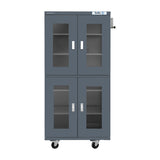
Electronic dry cabinet
A drying unit draws moisture from the cabinet air and sends it out of the cabinet.
The cabinet holds the humidity range you choose at order: 20 to 60, 10 to 20, 1 to 10 or 1 to 5 %RH. No desiccant to change and no gas to buy.
Nitrogen-purged dry cabinet
Dry nitrogen flows in and pushes the moist air out through a vent.
Set any level from 1 to 60 %RH. Purging stops at the target and starts again when the door opens, so humidity comes back down quickly.
How dry is dry enough
Relative humidity is a share of the water the air could hold. At 77 °F (25 °C) a cubic meter of room air at 50 %RH carries about 11.5 g of water. At 5 %RH it carries about 1.1 g, and it would have to cool to about 1 °F (−17 °C) before any of it condensed.
For moisture-sensitive surface-mount devices, IPC/JEDEC J-STD-033 sets two dry-cabinet levels. At 10 %RH or below, parts out of their moisture barrier bag can wait in the cabinet for a limited time. At 5 %RH or below, storage may be considered equivalent to a sealed dry pack with unlimited shelf life.
Water in the air at 77 °F (25 °C)
Grams of water per cubic meter of air, with the dew point below each label.
One scale from 0 to 12 g/m³. Calculated with the Magnus formula, dew point over water. Amber bars mark the two J-STD-033 dry-cabinet levels.
Electronic and nitrogen side by side
What each one is for
Corrosion needs both oxygen and water. Very dry air already slows it a great deal. Nitrogen also replaces the air that carries the oxygen, which matters for surfaces that must stay solderable or bondable.
Most dry storage, no gas line
- Surface-mount reels and trays out of their bags: 1–5 %RH for unlimited J-STD-033 storage, 1–10 %RH for short waits
- Optics, cameras and photographic material
- Hygroscopic samples, reagents and pharmaceutical materials
- Museum, archive and document storage
- Labs, stores and offices with no nitrogen supply
- Rooms where you would rather not add a gas line
You pick the humidity range when you order. Choose it for the strictest item you expect to store.
Ultra-dry and low in oxygen
- Semiconductor parts and plated or bare metal surfaces that must not oxidize
- Storage opened many times a shift, where humidity has to recover fast
- Sites with a house nitrogen line, a generator or a cylinder supply
- Set points down to 1 %RH, changed at any time
The U.S. Chemical Safety Board warns that "nitrogen is safe to breathe only when mixed with the appropriate amount of oxygen", and OSHA treats air below 19.5% oxygen as oxygen deficient. Place the cabinet in a ventilated room and ask your safety office about oxygen monitoring.
A two-question check
Price by size
For storage at 5 %RH or below, compare the electronic cabinet with the 1 to 5 %RH range against the nitrogen cabinet. The nitrogen cabinet costs less to buy in every size, but it needs gas for as long as it runs, and the amount grows with every door opening.
If general dry storage is enough, the electronic cabinet in 20 to 60 %RH starts at $2,899 for 320 L.
List price for 5 %RH storage
Blue: electronic, 1–5 %RH range. Amber: nitrogen-purged. Nitrogen supply not included.
One scale from $0 to $6,000. US list prices, November 2026.
Four sizes to scale
Both cabinets come in the same four sizes. The 320 L is a low unit at 39.8 in tall; the other three are full height. Every shelf is adjustable and rated for more than 176 lb (80 kg). Check door swing and the path through your doors before you order.
Outside dimensions, width × height. Depth: 17.7 in (320 L), 28.0 in (540 L), 23.6 in (870 L), 28.0 in (1436 L).
LORDERAN dry cabinets
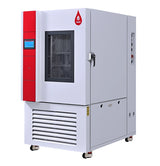
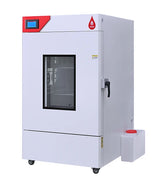
Both cabinets share the same body: airtight doors with locks, a dual LED display for humidity and temperature, an abnormal-humidity alarm with light and buzzer, and a 13-step powder coating. Both conform to IPC/JEDEC J-STD-033C and are CE and RoHS certified. See the dry cabinet collection.

- 20–60, 10–20, 1–10 or 1–5 %RH
- No gas, no desiccant
- 320 to 1436 L

- Set 1 to 60 %RH
- Auto stop at target
- 320 to 1436 L

- Fits either cabinet
- Rated over 176 lb (80 kg)
-
1HumidityYour strictest item decides the range.
-
2NitrogenSupply, regulator and ventilation, if you choose it.
-
3SizeShelf count and the path to the room.
-
4Power110 V or 220 V, 50/60 Hz.
Questions buyers ask
Which is better, a nitrogen or an electronic dry cabinet?
Neither in general. An electronic cabinet needs only power and covers 5 %RH storage with its 1 to 5 %RH range. A nitrogen cabinet adds an atmosphere low in oxygen and fast recovery after door openings, at the cost of a gas supply and a ventilated room.
What humidity does J-STD-033 require?
For moisture-sensitive surface-mount devices out of their bag, the standard allows a dry cabinet at 10 %RH or below for a limited time. At 5 %RH or below, storage may be considered equivalent to a sealed dry pack with unlimited shelf life. The standard's cabinet holds 25 ± 5 °C.
Does a dry cabinet control temperature?
No. Both LORDERAN dry cabinets control humidity only and display the temperature to ±1 °C. For a set temperature as well, use an environmental test chamber.
How much nitrogen does a nitrogen cabinet use?
It depends on the set point, the cabinet size and how often the door opens. The LORDERAN cabinet regulates the flow with a flowmeter and stops purging once the target is reached, so most of the gas goes into recovering after door openings.
Can I add shelves?
Yes. Extra shelves fit either cabinet, and every shelf is rated for more than 176 lb (80 kg). The 320 L and 540 L come with 3 shelves; the 870 L and 1436 L come with 5.
Sources
- IPC/JEDEC J-STD-033, Handling, Packing, Shipping and Use of Moisture/Reflow Sensitive Surface Mount Devices (1999 edition, hosted by NSWC Crane)
- I-Connect007: Long-term storage of electronic components, quoting J-STD-033 clauses 5.3.3.1 and 5.3.3.2
- U.S. Chemical Safety Board: Hazards of nitrogen asphyxiation
- U.S. Department of Energy: Oxygen deficient atmosphere hazards