

USP Apparatus 1 vs 2: Basket or Paddle for Dissolution Testing?
Short answer: use the apparatus and speed your monograph or approved method names. When you are developing a method, Apparatus 1 holds the dosage unit inside a rotating mesh basket, which suits capsules and units that float. Apparatus 2 lets the unit sink under a rotating paddle, and a sinker can hold down units that would float. Both run in a 1 L vessel at 37.0 ± 0.5 °C with the stirring element 25 ± 2 mm above the bottom, so one dissolution tester with both elements covers both methods.
Basket and paddle at work
Each vessel sits in a water bath that holds the medium at 37.0 ± 0.5 °C. The harmonized dissolution text requires the rotation speed to stay within ±4% of the set rate and allows no significant motion, agitation or vibration beyond that of the smoothly rotating element.
Apparatus 1, basket
The dosage unit sits inside a cylindrical mesh basket that turns in the medium.
The basket screen has 0.36 to 0.44 mm openings. FDA's compilation lists 50 to 100 rpm as the usual basket speed for immediate-release forms.
Apparatus 2, paddle
The dosage unit sinks to the vessel bottom under a turning paddle blade.
The paddle is a blade and shaft. FDA's compilation lists 50 to 75 rpm for tablets and capsules and 25 to 50 rpm for suspensions. Units that would float can be weighted with a sinker.
Basket and paddle side by side
Typical speeds
The agitation speed comes from the monograph or your validated method. During development, FDA's compilation of dissolution guidance lists the usual ranges for immediate-release solid oral dosage forms and notes that they are recommendations to be checked for suitability.
A tester's speed accuracy matters most at low speeds. LORDERAN testers hold ±2 rpm, which is within the ±4% tolerance at 50 rpm and above.
Usual agitation speeds, rpm
Immediate-release dosage forms, from FDA's compilation. The last bar is the LORDERAN speed range.
One scale from 0 to 200 rpm. Each bar spans the listed range.
A two-question check
Stations and test stages
The harmonized acceptance table for immediate-release forms tests in up to three stages. Each stage adds dosage units, so the number of vessels decides how many runs a batch can take.
LORDERAN dissolution testers
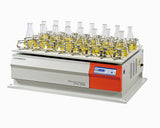
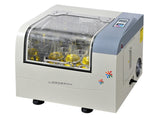
Every LORDERAN dissolution tester comes with SUS316L basket and paddle elements and holds its bath within ±0.3 °C. The RC series runs from room temperature to 45 °C and stores nine sampling times from 5 to 900 minutes; the PJ 4-in-1 bath runs at 20 to 40 °C. Choose by station count and head: turned over by hand, auto-lifting, or both. See the full range of dissolution testers.

- 1 or 3 stations
- Head turns over by hand
- Method development

- 6 stations; RC-8 adds 2 media vessels
- ChP 2020 parameters stored
- Head turns over by hand

- 3, 6 or 8 stations
- Lifts itself, turns over by hand
- USP, EP and ChP

- 6, 8 or 12 stations
- All vessels start together
- Beep at each sampling time

- Hardness, friability, disintegration, dissolution
- 3 or 6 dissolution stations
- Bath 20 to 40 °C
-
1MethodNote the apparatus, speed, medium and volume your monograph or method names.
-
2StationsSix runs Stage S1 in one pass; twelve runs S1 and S2 together.
-
3MediumVolume within ±1% of the stated amount; remove dissolved gases if they affect results.
-
4HeadA head that turns over by hand eases cleaning; auto-lifting starts all vessels together.
Every model page has a datasheet and a one-click PDF quotation.
Questions buyers ask
Can one tester run both Apparatus 1 and Apparatus 2?
Yes. Both use the same 1 L vessel, bath and drive; you change the stirring element. Every LORDERAN dissolution tester ships with SUS316L baskets and paddles.
Which apparatus should I use for capsules?
Follow the monograph. Without one, capsules are often tested in Apparatus 1, because the basket keeps the shell in place. The harmonized text also allows a sinker in Apparatus 2 for units that would otherwise float.
What speed should I start with?
FDA's compilation lists 50 to 100 rpm for the basket and 50 to 75 rpm for the paddle with tablets and capsules, and 25 to 50 rpm for suspensions. Confirm suitability during method development.
How accurate does the speed have to be?
The harmonized text requires the speed to stay within ±4% of the set rate. At 50 rpm that is ±2 rpm, the speed accuracy of LORDERAN testers.
How many vessels do I need?
Stage S1 tests 6 units, S2 adds 6 more and S3 adds 12. A six-station tester runs S1 in one pass. Twelve stations run S1 and S2 together when you expect to need both.