

Laminar Flow Hood vs Biosafety Cabinet: Which Do You Need?
Short answer: a laminar flow hood, also called a clean bench, protects only the sample. It blows HEPA-filtered air across the work and out toward you. A Class II biosafety cabinet protects the sample, you and the lab. If anything you handle could be infectious, is a cell culture material or a drug formulation, or is otherwise hazardous, you need a biosafety cabinet.
Who each one protects
A clean bench keeps particles off the sample and nothing more. Whatever comes off the sample travels with the air, out of the front opening and toward the person working there. A Class II biosafety cabinet pulls room air in at the front, away from you, and filters what it exhausts.
Based on BMBL 6th edition, Appendix A, which states that horizontal and vertical clean benches are not biosafety cabinets.
How the air moves
All three use HEPA filters and give the sample a work zone of ISO Class 5 or cleaner. The difference is the direction of the air after it passes the sample. In a clean bench it leaves through the front opening, toward your face and hands. In a biosafety cabinet, room air is drawn in through the front grille and away from you.
Horizontal laminar flow hood
HEPA filter on the back wall. Air crosses the work surface toward you.
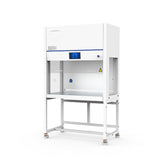
Vertical laminar flow hood
HEPA filter in the roof. Air falls on the work and leaves under the sash.
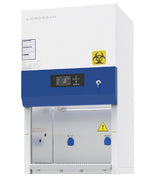
Class II biosafety cabinet
Room air is pulled in at the front grille. Exhaust passes a second filter.
What a clean bench is for
- Dust-free assembly of sterile equipment, electronics and optics
- Preparing culture media, plates and other sterile, non-hazardous materials
- Plant tissue culture
- In a vertical bench: preparing nucleic acids for PCR, and preparing intravenous solutions in a hospital pharmacy
BMBL lists PCR nucleic acid preparation and intravenous solution preparation as uses where a vertical clean bench may be useful. Everything at the bench must be non-hazardous.
What needs a biosafety cabinet
- Human and animal cell culture
- Microbiology and virology, and any potentially infectious sample
- Drug formulations
- Any other potentially hazardous material
BMBL states that clean benches should never be used when handling cell culture materials, drug formulations, potentially infectious materials or any other potentially hazardous materials.
A two-question check
Vertical or horizontal
Prices as of November 2026, with free delivery and duties paid to your loading dock. A biosafety cabinet also protects the sample, so it can do a clean bench's job. The reverse is not true.
LORDERAN laminar flow hoods
Every LORDERAN laminar flow hood gives an ISO Class 5 work zone through a HEPA filter rated 99.995% or better at 0.3 μm, with a pre-filter in front of it. Each has a UV lamp and runs at 65 dB(A) or less, and every model comes in 110 V or 220 V. They protect the sample only. For operator protection, see our biological safety cabinets.

- 2 ft (600 mm) benchtop
- 0.2 to 0.45 m/s, H14 HEPA
- One operator

- 1100, 1300 and 1500 mm
- 0.2 to 0.45 m/s, H14 HEPA
- One or two operators

- 1200 or 1700 mm interior
- Average 0.3 to 0.5 m/s
- LCD controller

- H1100 to H1800, 3.6 to 6 ft
- 0.3 to 0.5 m/s
- Open front or motorized window

- 5 ft or 6 ft
- 0.2 to 0.45 m/s, H14 HEPA
- Self-compensating airflow
Read how to choose between a Class II A2 and B2 biosafety cabinet.
A2 vs B2 guideEvery model page has a datasheet and a one-click PDF quotation.
Class II A2 and B2, from a 2 ft benchtop to 6 ft.
Questions buyers ask
Can I do cell culture in a laminar flow hood?
For human and animal cell culture, use a Class II biosafety cabinet. BMBL states that clean benches should never be used when handling cell culture materials, because the air leaving the bench carries whatever comes off the work toward the operator.
Is a laminar flow hood the same as a fume hood?
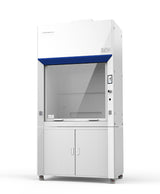
No. A chemical fume hood pulls room air away from you and exhausts it, which protects you from vapors but does nothing to keep the sample clean. A laminar flow hood blows filtered air over the sample and out toward you. Neither one is a biosafety cabinet.
Can a biosafety cabinet do the job of a clean bench?
Yes. A Class II cabinet also gives the sample HEPA-filtered downflow. The University of Delaware's biosafety office recommends buying biosafety cabinets for both purposes. The trade-off is price: a LORDERAN Class II A2 starts at $3,799, against $2,699 for a laminar flow hood.
What does ISO Class 5 mean?
ISO 14644-1 sets ISO Class 5 at no more than 3,520 particles of 0.5 μm or larger per cubic meter of air. It corresponds to the older US Class 100 rating, 100 particles per cubic foot.
Can I use a laminar flow hood for PCR set-up?
Yes, if the samples are non-hazardous. BMBL names the preparation of nucleic acids for PCR as a use where a vertical clean bench may be useful.
