
How to Choose a Lab Freeze Dryer: Cold Trap, Capacity and Chamber Type
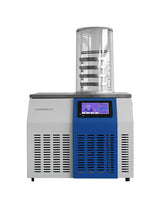
Short answer: choose the cold trap temperature from what is in your sample, the size from how much liquid you dry per run, and the chamber from the container you dry in. The cold trap should be at least 15 to 20 °C colder than the temperature at which your sample melts. A standard −60 °C trap covers samples that need a −40 °C collector, such as milk, blood plasma and serum. Acetonitrile or methanol calls for a cascade trap below −75 °C. LORDERAN freeze dryers come in three sizes and four chamber types, from $3,299 with duties paid to your dock.
How freeze drying works
FDA describes lyophilization as removing water from a product after it is frozen and placed under a vacuum, so the ice turns straight to vapor. The process has three stages: freezing, primary drying (sublimation) and secondary drying (desorption).
1. Freeze
The sample freezes solid before the pump starts.
On LORDERAN units you pre-freeze in the cold trap opening itself, so you do not need a separate freezer.
2. Primary drying
Under vacuum, ice sublimates without melting.
The vapor freezes out on the cold trap, which is why the trap's temperature and capacity matter.
3. Secondary drying
The last, bound water leaves the dry cake.
What is left keeps its structure and dissolves again when water is added.
1. Cold trap temperature
Labconco's freeze dryer manual says the collector should be at least 15 to 20 °C colder than the eutectic (melting) temperature of the sample. If the trap is too warm, the sample can melt back during the run. Volatile components such as acetonitrile and methanol make samples more likely to melt, and the same manual calls for cascade refrigeration that cools the collector below −75 °C.
Bars show degrees below 0 °C on one scale starting at zero. Blue: collector temperature the Labconco manual lists for each sample. Amber: LORDERAN cold trap options.
The LORDERAN drying chamber cover is acrylic. If you plan to dry samples in organic solvents, send us the solvent and concentration before you order so we can check that the chamber and pump suit it.
2. Size by liquid per run
The litres in a model name describe the cold trap. To size a freeze dryer, look at how much liquid one run takes and how much water the trap catches in a day.
-
1Liquid per run2.4 L on the 6 L and 9 L models, 3.6 L on the 28 L, with trays or flasks. The stoppering versions take 1.6 to 1.8 L in vials.
-
2Water caught per 24 h3 to 4 L on the 6 L and 9 L, 6 L on the 28 L. A run is listed at 36 hours, and you defrost between runs.
-
3Spread it thinLabconco notes that efficiency depends on the surface area and thickness of the sample, and recommends shell freezing flasks. LORDERAN trays are 20 mm (0.8 in) deep.
-
4One flask at a timeAdd flasks to a manifold one by one so the vacuum can recover between them.
3. Chamber type
Every size comes in four versions. Pick by the container you dry in: open trays, flasks on a manifold, or vials you seal under vacuum. FDA describes the vial route as freezing partially stoppered vials on shelves, drying under vacuum, then stoppering them completely, usually with a hydraulic or screw-rod mechanism.
S · Standard chamber
Stainless steel trays for bulk liquid, paste and solids.
P · Standard with manifold
The same trays plus an 8-port manifold for flasks.
T · Stoppering chamber
Three adjustable trays of vials, stoppered under vacuum.
PT · Stoppering with manifold
Vials inside and flasks outside in one unit.
The three sizes side by side
All three reach ≤ 5 Pa (0.05 mbar) with the supplied pump and use the same four chamber types. Prices cover S to PT and include duties-paid delivery.
Three questions to decide
Each question settles one choice: the first the cold trap, the second the chamber, the third the size.
Each no keeps the default: the standard −60 °C cold trap, an S or P chamber, and the 6 L benchtop or the 9 L unit on castors. P adds the flask manifold for $300 to $400.
LORDERAN freeze dryers
Each size ships with the vacuum pump, trays, drying rack and acrylic cover, with a 2-year warranty. Choose the chamber type and voltage on the product page.

- 2.4 L liquid per run
- 3–4 L water per 24 h
- 110 V or 220 V

- 2.4 L liquid per run
- 9 L cold trap
- 110 V or 220 V

- 3.6 L liquid per run
- 6 L water per 24 h
- −110 °C cold trap option
Questions
Is −60 °C cold enough?
For samples that need a −40 °C collector, such as milk, blood plasma and serum in the Labconco table, yes. Check the melting temperature of your sample and keep the trap 15 to 20 °C colder. Volatile solvents need the −80 °C or −110 °C option.
Do I need a separate freezer?
No. The cold trap opening is large enough to pre-freeze samples in the machine itself.
How long does a run take?
The listed freeze-drying time is 36 hours. Thicker layers take longer, because efficiency depends on the surface area and thickness of the sample. Defrost the cold trap between runs.
What vacuum does it reach?
≤ 5 Pa (0.05 mbar) with the supplied pump: 2 L/s on the 6 L and 9 L, 4 L/s on the 28 L.
Can I run it on 110 V?
Yes. Every size and chamber type is offered in 110 V and 220 V at the same price.
What is the difference between S, P, T and PT?
S has trays for bulk material. P adds an 8-port manifold for flasks. T has three adjustable trays and a top-press device that stoppers vials under vacuum. PT combines the stoppering chamber with the manifold.
Sources
- FDA, Guide to Inspections of Lyophilization of Parenterals (7/93)
- Labconco FreeZone freeze dryer user's manual, chapter 1 (hosted by NIST)
- LORDERAN BK-FD10, BK-FD12 and BK-FD18 datasheets and product pages