

How to Choose a Lab Shaker: Open-Air, Incubated, CO₂ or Water Bath
Short answer: start from the temperature your work needs and where the shaker will stand. An open-air shaker runs in a warm room, cold room or temperature-controlled lab and has no heating or cooling of its own. An incubated and refrigerated shaker sets its own temperature from 4 to 60 °C. A CO₂ incubator shaker adds CO₂ and humidity control for mammalian suspension culture. A shaking water bath heats up to 99.9 °C for enzyme reactions and hybridization. Then size it by flask count and pick the orbit.
Four kinds of shaker
All four move flasks or vessels continuously so cultures stay mixed and oxygenated. They differ in what surrounds the flasks: room air, a heated and cooled chamber, a chamber with CO₂ and humidity, or a tank of heated water.
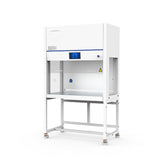
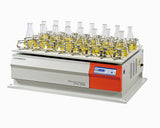
Open-air orbital shaker
The platform circles on a balanced drive in whatever room it stands in.
From $2,899. 30 to 300 rpm; 25, 50 or 100 mm orbit; up to 96 flasks of 250 ml on one platform, or 450 on a six-tier frame.
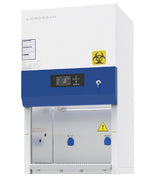
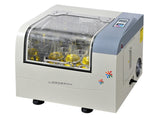
Incubated and refrigerated shaker
A heated and cooled chamber holds a set temperature around the moving flasks.
From $3,999. 4 to 60 °C to ±0.1 °C; 0 to 400 rpm depending on model; 80 L benchtop to 245 L floor models, and stackable units three high.
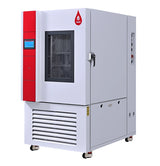
CO₂ incubator shaker
CO₂ and humidity are controlled in the chamber as in a static CO₂ incubator.
From $13,999. CO₂ 0.1 to 20 % on an IR sensor, active humidity up to 95 %RH, 4 to 60 °C, 170 to 282 L, stackable.
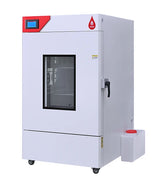
Shaking water bath
Flasks sit in heated water while the rack moves back and forth.
From $3,899. Room temperature + 5 °C to 99.9 °C, ±0.1 °C; 20 to 200 rpm; 316L stainless liner, 46 to 170 L. It does not cool.
What each one can do
Open-air tiers: the multi-tier frame. Incubated stacking: the stackable series. The CO₂ shaker needs a room between 18 and 34 °C.
How cold, how hot
A refrigerated shaker cools relative to the room, so the lowest temperature depends on your lab. Check the room temperature in summer before you count on 4 °C. A water bath works the other way: it heats from a few degrees above room temperature and cannot cool.
Orbit, speed and fill volume
Oxygen reaches a shaken culture through the liquid the motion spreads over the flask wall. A 2025 study from RWTH Aachen notes that in standard shake flasks, raising the shaking diameter or the shaking frequency is the only way to increase oxygen transfer without side effects on the culture.
The push on each flask grows with the square of the speed and in proportion to the orbit. Doubling the orbit doubles it at the same speed, so a larger orbit mixes large flasks without running faster.
Peak acceleration on the platform
In multiples of g, from (2π × rpm / 60)² × orbit radius.
One scale from 0 to 3 g. Blue: 200 rpm. Amber: 300 rpm.
LORDERAN orbits: 25 mm on incubated and CO₂ shakers (50 mm optional on the CO₂ models), 25 or 50 mm on the benchtop open-air shaker, 50 or 100 mm on the floor open-air shaker and 50 mm on the multi-tier frame.
A three-question check
LORDERAN shakers
The shakers in this guide hold speed to ±1 rpm on a balanced drive that stays quiet and steady at full load, store their settings, and run programs of up to eight steps. See every model in the lab shaker collection.

- 30–300 rpm, 25 or 50 mm orbit
- Up to 35 × 250 ml flasks
- Flasks up to 5000 ml

- 50 or 100 mm orbit
- Up to 96 × 250 ml flasks
- Warm room or cold room

- 2, 4 or 6 shaking plates
- Up to 450 × 250 ml flasks
- 50 mm orbit

- 4–60 °C, ±0.1 °C
- 30–400 rpm
- Up to 18 × 250 ml flasks

- 84 to 180 L, stacks 3 high
- Orbital or reciprocating
- 4–60 °C

- 186 or 245 L
- ±0.2 °C uniformity
- Up to 43 × 250 ml flasks

- 0.1–20 % CO₂, ≤ 95 %RH
- 170 to 282 L, stackable
- 25 or 50 mm orbit

- Room + 5 °C to 99.9 °C
- 20–200 rpm, reciprocating
- 46, 82 or 170 L
-
1TemperatureThe range you need and your lab's summer temperature.
-
2FlasksCount and size; that sets the platform or chamber.
-
3SpaceBench, floor or stacked, and the path into the room.
-
4Supply110 V or 220 V; a CO₂ line for CO₂ models.
Questions buyers ask
Orbital or reciprocating shaking?
Orbital shaking moves the platform in a small circle and is the usual choice for culture flasks. Reciprocating shaking moves it back and forth in a straight line, as in the shaking water bath. Three of the four stackable incubated models can switch between the two.
Can an open-air shaker run in a cold room or warm room?
Yes. The floor-standing open-air shaker is rated for warm rooms and cold rooms. The benchtop and multi-tier models are rated for temperature-controlled labs and warm rooms.
How cold can an incubated shaker get?
Cooling works relative to the room: 15 °C below it on the 80 L benchtop model and 18 °C below it on the stackable and CO₂ models, never lower than 4 °C. In a warm lab the lowest temperature is higher.
What does a CO₂ incubator shaker need on site?
A CO₂ supply, a room between 18 and 34 °C, and 220 V or 110 V power. At 220 V the rated current is 11.6 to 14 A depending on the model.
What happens after a power cut?
The open-air models resume the run with the previous settings when power returns. The incubated models and the water bath keep their parameters in memory.
