

Ducted vs Ductless Fume Hood: Which Is Right for Your Lab?
Short answer: choose a ducted fume hood for most chemistry. It sends vapors out of the building, copes with whatever chemicals you use next year and keeps exhausting during a spill. A ductless hood filters the air and returns it to the room, so it fits only small quantities of known chemicals that its filters are rated for, in work that would be safe on an open bench, and usually only with your safety office's approval.
Where the vapors go
Both types pull room air in at the sash and away from you. The difference is what happens next. A ducted hood carries the vapors through a duct to a fan that discharges them outside. A ductless hood passes them through carbon or chemical filters and returns the air to the lab, so anything the filter does not hold stays in the room.
Based on the NIH Division of Occupational Health and Safety review of ductless fume hoods, which found that a ductless unit would not adequately contain a 500 ml spill.
How the air moves
In both hoods a blower pulls room air in through the sash opening, over the work and away from your breathing zone. In a ducted hood that air ends up outside. In a ductless hood it ends up back in the lab after one pass through the filters.
Ducted fume hood
Vapors are drawn behind the rear baffle and up the duct to a fan outside.
The rear baffle spreads the suction across the back of the hood so vapors are pulled away from the sash. The duct and roof fan are part of the building, and the room needs supply air to replace what the hood exhausts.
Ductless fume hood
Vapors pass through carbon or chemical filters. The air returns to the room.
Each filter holds a limited amount of a given chemical. In NIH testing, breakthrough appeared within 12 to 24 hours depending on the solvent and its concentration. The filters must be changed before they saturate and disposed of as chemical waste.
Sash height and face velocity
Face velocity is the speed of the air entering the sash opening. A blower moves a fixed volume of air, so a lower sash makes the same air enter faster and capture vapors more reliably.
California's laboratory hood rule (Title 8, section 5154.1) requires an average face velocity of at least 100 fpm, with no point below 70 fpm. Many labs elsewhere use a similar target. Mark the sash height that gives your target and work at or below it.
Have the face velocity measured on site after installation, and again after any change to the building exhaust.
Face velocity by sash opening, LORDERAN FH1200X
780 m³/h exhaust across a 1080 mm wide opening, assuming all air enters at the sash. The dashed line marks 100 fpm.
Calculated from the listed exhaust volume at full blower speed. Bars share one scale, starting at zero.
Ducted and ductless side by side
When you need a ducted hood
- General chemistry, where the chemicals change from project to project
- Acid digestion, heated reactions and strong acids or alkalis
- Volatile solvents in more than small quantities
- Any work your safety office would not allow on an open bench
NIH notes that a standard chemical fume hood will accommodate almost any change in the chemicals being used, and that in a spill it will exhaust the vapor out of the lab.
When a ductless hood can fit
- Small quantities of one known chemical that the filter is rated for
- Work that would be safe on an open bench, such as odor control
- Rooms with no route for an exhaust duct
- Where your safety office has approved it, with a filter change schedule
Oregon State University EHS limits ductless hoods to work that can be safely performed on an open bench and requires a written procedure, a filter change-out schedule and annual filter testing.
A three-question check
LORDERAN prices from, as of November 2026, with free delivery and duties paid to your loading dock. A ducted hood also needs a duct route, make-up air and balancing, which are building work.
LORDERAN fume hoods
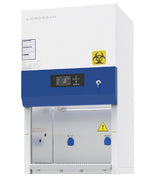
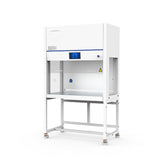
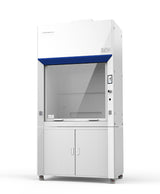
Seven ducted models and one ductless hood. The ducted hoods connect to a PVC exhaust duct; the benchtop and series hoods have a built-in centrifugal blower with adjustable speed, and the walk-in hood uses an external blower. The A, E and X Series and the ductless hood resist weak acids and alkalis; the P Series has a PP body for strong acids and alkalis.

- 27 in, on an existing bench
- 250 m³/h, carbon filter
- 4 m duct included

- Motorized window, carbon filter
- 630 to 1,210 m³/h
- Taps, sink and UV standard

- Motorized sash
- 590 to 1,170 m³/h
- 3.28 to 5.9 ft

- Manual sash, tap and sink
- 570 to 1,140 m³/h
- 4.3 m duct included

- PP body, acid-resistant glass
- 560 to 1,130 m³/h
- 9-speed PP blower

- Smart touch-screen control
- 2,300 m³/h exhaust
- One or two operators

- Floor-level, 1670 mm tall inside
- 1,150 to 1,850 m³/h
- External blower

- 2 to 4 chemical filters
- 136 to 415 m³/h
- Touch screen, room sensor
Every model page has a datasheet and a one-click PDF quotation.
A fume hood does not protect the sample. Read how a Class II B2 cabinet handles both.
A2 vs B2 guideQuestions buyers ask
Is a ductless fume hood safe?
It can be, for a narrow job. The filters must be rated for the chemicals you use, the quantities must stay small and the filters must be changed before they saturate. NIH found the risks too great and does not permit ductless hoods in its labs. Ask your safety office before you buy one.
Can a ductless fume hood handle acids?
Our ductless hood resists weak acids and alkalis, and its filters are chemical filters for gaseous pollutants such as VOCs. For acid digestion, heated acids or strong acids, use a ducted hood. The LORDERAN P Series is built for strong acids and alkalis.
How often do the filters need changing?
It depends on the chemical, the quantity and how long the hood runs. In NIH testing, breakthrough appeared within 12 to 24 hours for some solvents. Follow the filter supplier's rating for your chemicals, log every change and check the filters after any spill.
What face velocity should a fume hood have?
California's Title 8, section 5154.1 requires an average of at least 100 fpm (0.5 m/s), with no point below 70 fpm. Test the hood on site after installation. ASHRAE 110 is the usual test method.
Can a fume hood replace a biosafety cabinet?
No. A fume hood protects you from chemical vapors but does not filter the air that reaches the sample or the air it exhausts. For biological work, use a Class II biosafety cabinet. See our A2 vs B2 guide and laminar flow hood vs biosafety cabinet.
