

How to Choose a Lab Autoclave: Size, Type and Cycles
Short answer: size the autoclave by the largest load you run in one cycle, with room left for steam to reach every item. Most labs that sterilize media, glassware and waste choose a 50 to 100 L vertical autoclave. Choose a horizontal 150 L or larger for high volume, and plan for three-phase power and a water supply. Then pick features by load: liquids need a slow exhaust, instruments and glassware need drying, and sealed food packs need counter-pressure.
How steam replaces air
An autoclave sterilizes with saturated steam under pressure, usually at 121 °C (250 °F) or 132 to 134 °C. Air has to leave the chamber first. CDC notes that air that is not removed will interfere with steam contact, and an air and steam mixture at the same pressure is cooler than pure steam.
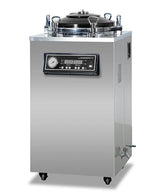
Vertical autoclave
Water in the base boils into steam. Cold air is purged through the exhaust before the hold starts.
LORDERAN vertical lab autoclaves sterilize at up to 134 °C at a working pressure of 0.23 MPa (33 psi). Their non-vent or liquid mode keeps the vessel sealed so pressure falls slowly and liquids do not boil over.
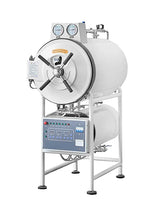
Horizontal, gravity displacement
Steam enters from the top and pushes heavier cold air out through the drain.
Prevacuum sterilizers use a vacuum pump instead, which removes air faster from porous and wrapped loads. In CDC's table, a prevacuum cycle for wrapped instruments needs 4 minutes at 132 °C against 15 minutes in gravity displacement.
Chamber sizes, drawn to scale
The listed volume is the chamber; the baskets are smaller. Size for the largest load you run in one cycle and leave space between items. University of Kentucky Research Safety advises against crowding items or overfilling bags and containers, and against sealing bottles tightly, so steam can reach every surface.
Vertical, top-loading
Chamber diameter × depth, mm
Horizontal, front-loading
Chamber diameter × length, mm
Both drawings use the same scale. Chamber sizes from the LORDERAN specifications; the 75 L size is offered in the drying and four-mode vertical models.
Vertical or horizontal
Cycles by load
Temperature and time depend on the load and on how the autoclave removes air. The figures below are minimum exposure times at temperature. Heat-up, exhaust and drying come on top, so a full cycle takes much longer than the hold.
Power and circuits
Check the circuit before you order. A vertical autoclave heats its water with 2.5 to 4.5 kW of elements, so the current at 120 V is high. Every LORDERAN vertical model offered in 110 V draws more than 20 A at 120 V.
At 220 V the same units draw 12 to 20.5 A. The 150 L vertical runs on 220 to 240 V only and draws 27 A. Horizontal autoclaves need a three-phase supply and a water connection.
Ask your electrician to confirm the circuit and plug type for the model you choose.
Current draw at 120 V, LORDERAN vertical autoclaves
Listed current for the 110 V versions. The dashed line marks 20 A.
The 35 L with drying uses 3 kW and draws 25 A at 120 V. Bars share one scale, starting at zero.
A three-question check
LORDERAN prices from, as of November 2026, with free delivery and duties paid to your loading dock.
LORDERAN autoclaves
Four vertical models and one horizontal model. The vertical autoclaves sterilize at up to 134 °C at a working pressure of 0.23 MPa (33 psi), with a sterilization timer of up to 999 minutes. The drying and four-mode models condense exhaust steam in a built-in tank or bottle, so no steam is vented into the lab.

- 35, 50, 100 and 150 L
- 116 to 134 °C
- Non-vent mode for liquids

- 35 to 100 L, hand-wheel lid
- Drying up to 240 min
- Steam condensed in a tank
- Solid, liquid, agar, custom
- 106 to 134 °C, 35 to 100 L
- Condensate bottle, drying

- 100 or 150 L
- Air compressor standard
- Pouches, cans, jars

- 150, 200, 300 and 400 L
- Gravity displacement
- Three-phase, 12 to 18 kW
-
1LoadYour largest load fits the baskets with space between items.
-
2PowerThe circuit and plug match the model: current at 120 V or 220 V, or three-phase.
-
3CyclesLiquids need a liquid or non-vent mode; instruments and glassware need drying.
-
4ValidationPlan biological indicator tests, monthly for biohazardous waste.
See all autoclaves. Every model page has a datasheet and a one-click PDF quotation.
Questions buyers ask
What size autoclave do I need?
Take the largest load you run in one cycle, put it in the baskets with space between items, and choose the chamber that holds it. If you run several loads a day, a larger chamber cuts the number of cycles. Compare basket sizes as well as the listed volume.
Can I autoclave liquids and media?
Yes, with a liquid cycle. The LORDERAN vertical autoclaves have a non-vent or liquid mode that lets pressure fall slowly so liquids do not boil over. Leave caps loose so steam can enter the bottles.
Do I need a 220 V circuit?
Not always, but every LORDERAN vertical model offered in 110 V draws more than 20 A at 120 V, from 21 A for a 35 L to 37.5 A for a 100 L. At 220 V they draw 12 to 20.5 A. Confirm the circuit with your electrician before you order.
What should never go in an autoclave?
University of Kentucky Research Safety lists volatile or corrosive chemicals, radioactive materials, sharps containers, and red-bag regulated medical waste.
How do I know a cycle worked?
CDC notes that the effectiveness of steam sterilization is monitored with a biological indicator. University of Kentucky requires autoclaves that decontaminate biohazardous waste to be verified monthly. Chemical indicator tape only shows that the item was exposed to heat.
Do I need a prevacuum autoclave?
Prevacuum cycles remove air faster from porous and wrapped loads, which shortens the hold, as in CDC's 4 minutes at 132 °C for wrapped instruments. Gravity displacement handles media, glassware, unwrapped items and waste, with longer holds.
