

RPM vs RCF (× g): How to Convert and Choose a Centrifuge
Short answer: protocols give centrifuge speed in × g because force, not rpm, does the separating, and the same rpm gives more force in a larger rotor. Convert with RCF = 1.118 × 10⁻⁵ × r × rpm², where r is the rotor radius in centimeters. To choose a centrifuge, find the highest × g your protocols call for and the largest volume per run, then pick the class that covers both.
Same rpm, different force
The force on a sample grows in proportion to its distance from the center of rotation. Run two rotors at the same speed and the sample in the larger one feels more force. That is why a protocol written as "4000 rpm" gives different results on different centrifuges, and "× g" does not.
Small rotor
Micro-tube rotor, sample about 62 mm from the center.
At 4000 rpm the sample feels about 1,100 times gravity. The same rotor reaches 30,642 × g at 21,000 rpm on the TGL-21M.
Large rotor
4 × 750 ml swing rotor, sample about 211 mm from the center.
At the same 4000 rpm the sample feels about 3,780 times gravity, more than three times as much, as on the DL-5B.
The conversion
Relative centrifugal force (RCF) is the force on the sample as a multiple of Earth's gravity. It depends on the square of the speed, so doubling the rpm gives four times the force, while doubling the radius only doubles it.
Use the radius to the sample. Rotor data usually gives r max, the distance to the bottom of the tube, which is where pellets form.
Example: 8000 rpm at r = 12.7 cm gives 1.118 × 10⁻⁵ × 12.7 × 8000² ≈ 9,100 × g, the TDL-8A maximum.
RPM for common × g
Speed needed to reach each force at four rotor radii, rounded to the nearest 10 rpm. Check the result against your rotor's maximum speed before you run it.
Calculated with RCF = 1.118 × 10⁻⁵ × r × rpm². 6 cm is typical of micro-tube rotors; 15 to 20 cm of large swing rotors.
Worked example: serum tubes
BD states that its Vacutainer SST and PST gel tubes should be spun at room temperature at 1000 to 1300 RCF, for 10 minutes in a swing-bucket centrifuge or 15 minutes in a fixed-angle one. Here is that range on a TDL-5A swing rotor with r ≈ 15.7 cm.
The TDL-5A and TGL-21M both have a Speed / RCF mode that converts for the selected rotor, so you can enter 1300 × g directly. Step by step: how to use a lab centrifuge.
How much force each class reaches
Low-speed benchtop and large-capacity centrifuges reach a few thousand × g: enough for blood tubes, cell pellets and bottles. High-speed models reach tens of thousands of × g in smaller tubes.
The force a centrifuge reaches depends on the rotor. Large buckets run slower than micro-tube rotors, so the top figure comes from the smallest rotor in each machine.
Maximum RCF by model
Blue: low speed and large capacity. Amber: high speed.
One scale from 0 to 65,000 × g.
A two-question check
LORDERAN centrifuges
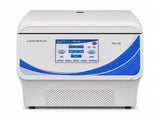
Every model locks its lid while running, and the refrigerated models hold −20 to +40 °C. The TGL-21M, L580R, DL series and floor high-speed models add an imbalance alarm. The DL-5B and DL-5M also come as ambient versions, D5M and D5B. See every model in the centrifuge collection.

- 5000 rpm, 4390 × g
- Blood tubes and microplates
- −20 to +40 °C

- 8000 rpm, 9100 × g
- Swing buckets to 4 × 500 ml
- −20 to +40 °C

- 5800 rpm, 5060 × g
- Up to 4 × 750 ml
- 110 V or 220 V

- 5000 rpm, 3780 × g
- Up to 4 × 750 ml, floor
- Refrigerated or ambient

- 5000 rpm, 4640 × g
- Up to 4 × 1000 ml, floor
- Refrigerated or ambient

- 21,000 rpm, 30,642 × g
- Micro tubes to 4 × 750 ml
- Benchtop

- 22,000 rpm, 52,000 × g
- Up to 6 × 600 ml
- USB run records

- 25,000 rpm, 64,983 × g
- Up to 4 × 1000 ml
- Continuous-flow rotors
-
1ForceThe highest × g in your protocols.
-
2VolumeTube type, tube count and bottle size per run.
-
3TemperatureRefrigerated, or ambient for samples that need no cooling.
-
4Space and powerBench or floor, and the supply each model needs.
Questions buyers ask
Should I set rpm or × g?
Set × g whenever the protocol gives it. The TDL-5A and TGL-21M convert between the two for the selected rotor; on any model you can work out the rpm with the formula or the table above.
Which radius do I use in the formula?
The distance from the rotor axis to the sample. Rotor tables usually give r max, to the bottom of the tube, where the pellet forms. A sample near the top of the tube feels less force.
Why do swing-bucket and fixed-angle times differ?
The tube sits at a different angle and the sample travels a different path. BD, for example, gives 10 minutes for its gel tubes in a swing-bucket centrifuge and 15 minutes in a fixed-angle one at the same force.
How fast can a large bottle rotor run?
Slower than a micro-tube rotor. On the TGL-21M the swing rotors take up to 4 × 750 ml at 4000 rpm, while its angle rotors run micro tubes to 21,000 rpm.
Do I need a refrigerated centrifuge?
Choose one when samples must stay cold or at a set temperature during the run. For samples that need no cooling, the D5M and D5B run at room temperature for less.
