
How to Choose a CO₂ Incubator: CO₂ Level, Sensor, Jacket and Care
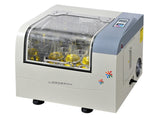
Short answer: a CO₂ incubator holds three things steady: temperature, CO₂ and humidity. Set the CO₂ level from the bicarbonate in your medium; ATCC grows most cell lines at 37 °C with 5 % CO₂. Choose an infrared CO₂ sensor if several people open the door through the day or you log CO₂ for GMP work. An air jacket recovers faster after door openings, and a water jacket holds heat longer when the room or the power is unstable. Then size the chamber to your vessels and plan a gas cylinder, a stand and a cleaning routine. The LORDERAN C-II series is air-jacketed with an infrared sensor, in 80 L and 160 L, from $5,999.
What a CO₂ incubator controls
Every design choice below serves one of three conditions in the chamber. Each time the door opens, all three drift, and the incubator has to bring them back.
Temperature
Heaters around the chamber hold the set point.
The C-II series runs from 5 °C above room temperature to 60 °C, with ±0.3 °C fluctuation at 37 °C.
CO₂
Gas from a cylinder, metered by a sensor.
CO₂ dissolves in the medium and, with its bicarbonate, sets the pH your cells grow at.
Humidity
A water pan keeps the air moist.
The University of Utah notes that a drop in humidity leads to evaporation from the culture medium.
1. CO₂ level and your medium
ATCC incubates most cell lines at 37 °C with 5 % CO₂, and recommends 10 % CO₂ for DMEM made with 3.7 g/L bicarbonate. Thermo Fisher gives the same range: 5 % to 10 % CO₂ for media with 2.0 to 3.7 g/L sodium bicarbonate. More bicarbonate needs more CO₂ for the same pH.
pH calculated with the Henderson–Hasselbalch equation (pKa 6.1, CO₂ solubility 0.0307 mM/mmHg, water-saturated air at 37 °C), from the bicarbonate in each standard formulation. Serum, HEPES and cell metabolism shift the real value.
The C-II series controls CO₂ from 0 to 20 vol% in 0.1 vol% steps, which covers both the 5 % and the 10 % set points.
2. IR or TC sensor
A thermal conductivity (TC) sensor reads CO₂ from how well the chamber gas conducts heat. Water vapor changes that too, so Lab Manager notes that TC readings can drift in a humid chamber. An infrared (IR) sensor measures the light CO₂ absorbs, independent of humidity.
-
1When IR is worth itBoston University's incubator care guide prefers IR for cGMP monitoring and when the door is opened repeatedly over a short period, as in time-lapse work.
-
2Check it anywayThe University of Utah recommends checking CO₂ calibration regularly with a CO₂ analyzer or handheld sensor.
-
3On the C-II seriesA dual-channel, dual-filter IR sensor, supplied with a calibration certificate.
3. Air or water jacket
NuAire's selection guide advises a water-jacketed model where the room temperature is unstable, because water holds heat, and a direct-heat (air-jacketed) model where the door opens often, because it restores chamber temperature faster. The LORDERAN C-II series is air-jacketed.
Air jacket
Heaters on the chamber walls, air around them.
Water jacket
Heated water surrounds the chamber.
4. Contamination control
Boston University's guide warns that every door opening lets contaminants in. The same guide says an automated heat decontamination cycle can replace the manual disinfection step. The C-II series runs a 90 °C moist heat cycle to decontaminate the chamber between culture runs. The routine below follows the University of Utah fact sheet.
Avoid chlorine. Utah warns that chlorine bleach corrodes stainless steel and copper and is toxic to cultured cells, and Boston University says never to use bleach-containing cleaners. Do not use tap, deionized or ultrapure water in the pan either: Utah recommends sterile distilled water at pH 7 to 9.
5. Size, gas and site
Measure your largest stack of flasks or plates against the inside dimensions, then plan the room.
-
1A stand, not the floorBoston University advises a firm, level stand away from vibration, airstreams and direct sunlight. Nothing stored on top.
-
2Room temperatureThe C-II series needs 5 to 30 °C ambient, ideally 25 ± 2 °C. Its lowest set point is room temperature plus 5 °C.
-
3A CO₂ cylinderBoston University recommends gas at least 99.5 % pure, a cylinder without a siphon tube and a two-stage regulator. Set the inlet pressure your incubator's manual gives.
-
4Power110 V or 220 V, chosen when you order; 650 or 700 W.
Three questions to decide
Each question settles one choice: the sensor, the jacket and the size.
Each no points to the 80 L C80II with its infrared sensor and air jacket.
LORDERAN CO₂ incubators
One series in two sizes with the same controls: PT100 temperature sensor with PID control, infrared CO₂ sensor, 7-inch touch screen, two adjustable shelves and a 304 stainless steel chamber. Each comes with a 2-year warranty and is delivered duties paid.

- IR CO₂ sensor, 0–20 vol%
- RT + 5 to 60 °C, 90 °C decon cycle
- 110 V or 220 V
- Same controls as the C80II
- Inside 18.4 × 21.7 × 25.5 in
- 110 V or 220 V
Questions
What CO₂ level should I set?
Follow the product sheet for your cell line. ATCC grows most lines at 5 % CO₂ and uses 10 % for DMEM with 3.7 g/L bicarbonate.
Does the C-II series control humidity?
Humidity comes from the bottom water reservoir. The incubator displays it in real time and alarms on low water; no humidity set point is specified.
What water goes in the pan?
Sterile distilled water. Utah recommends pH 7 to 9 and warns that deionized or ultrapure water corrodes stainless steel. Tap water with chlorine does too.
Is the 90 °C cycle used during incubation?
No. Incubation runs from room temperature plus 5 °C to 60 °C. The 90 °C moist heat cycle is a separate step to decontaminate the empty chamber.
What alarms does it have?
High and low temperature, high and low CO₂, low water level, plus leakage-current and over-voltage protection.
Sources
- ATCC, Animal Cell Culture Guide and Cell Culture 101
- Thermo Fisher, Cell Culture Troubleshooting Guide
- Boston University EHS, Proper Care for Cell Culture Incubators
- University of Utah IBC, Best Practices for CO₂ Incubator Maintenance
- NuAire, CO₂ incubator selection white paper
- Lab Manager, CO₂ Incubators: How to Control Culture Conditions
- LORDERAN C80II / C160II datasheet and product page